
Event Recap
By Eric Hoke, Design Director
3 min read: The Civic Design Center welcomed special guest, Khalil Shahyd, from Washington D.C. for this event! Khalil Shahyd, PhD, is a Senior Strategist on AI and Data Centers with the National Resources Defense Council (NRDC) where he leads their work on ensuring AI and its related infrastructure doesn't undermine our climate ambitions, increase environmental burdens, or exacerbate inequality.
or listen to the whole discussion using the player below:
At the Civic Design Center, we spend a lot of time thinking about how the built environment shapes daily life in Nashville and how streets connect neighborhoods, how public spaces help people connect, and how new development can strengthen the fabric of our communities. Lately, however, a very different kind of building typology has been dominating regional conversations: the hyperscale data center.
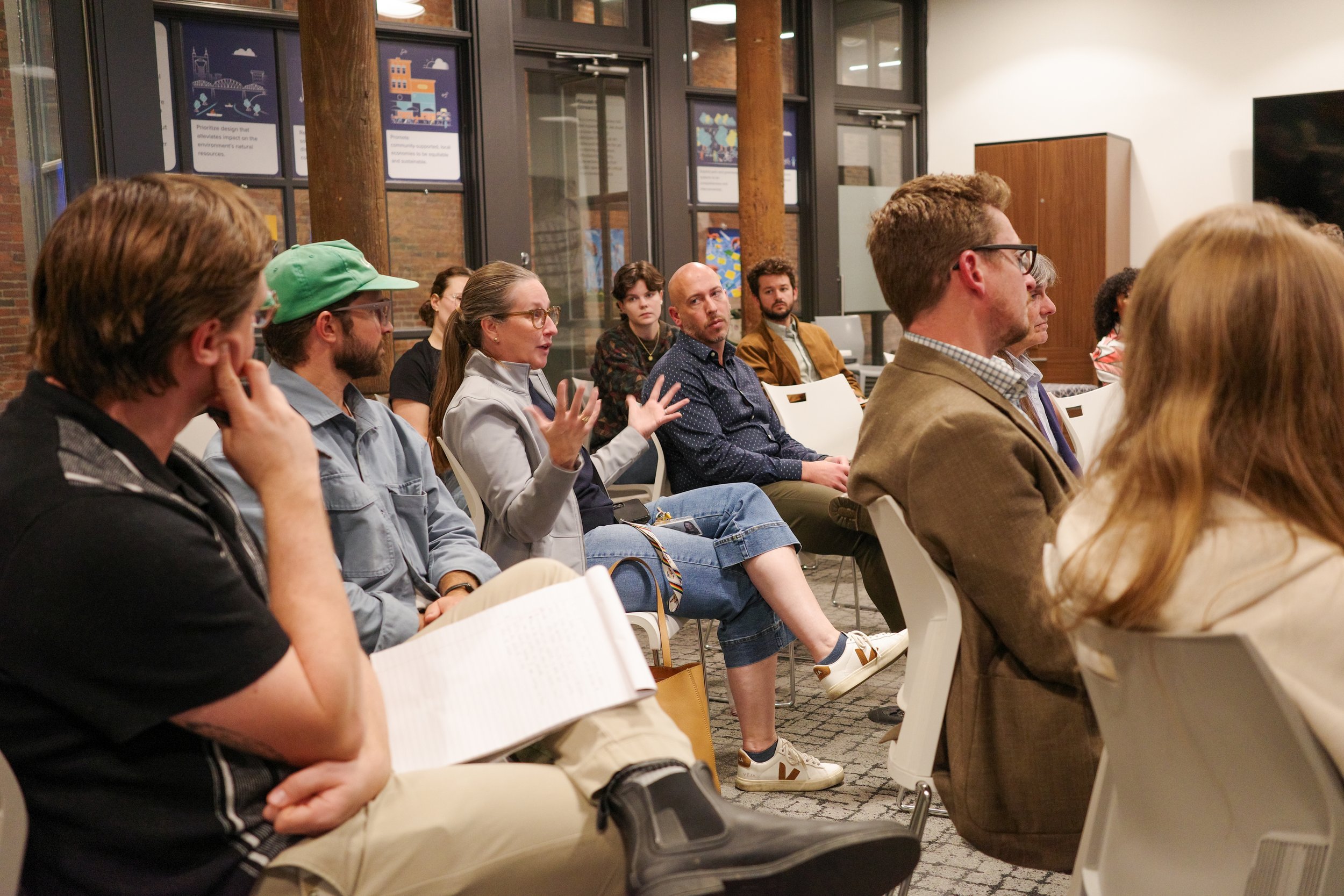
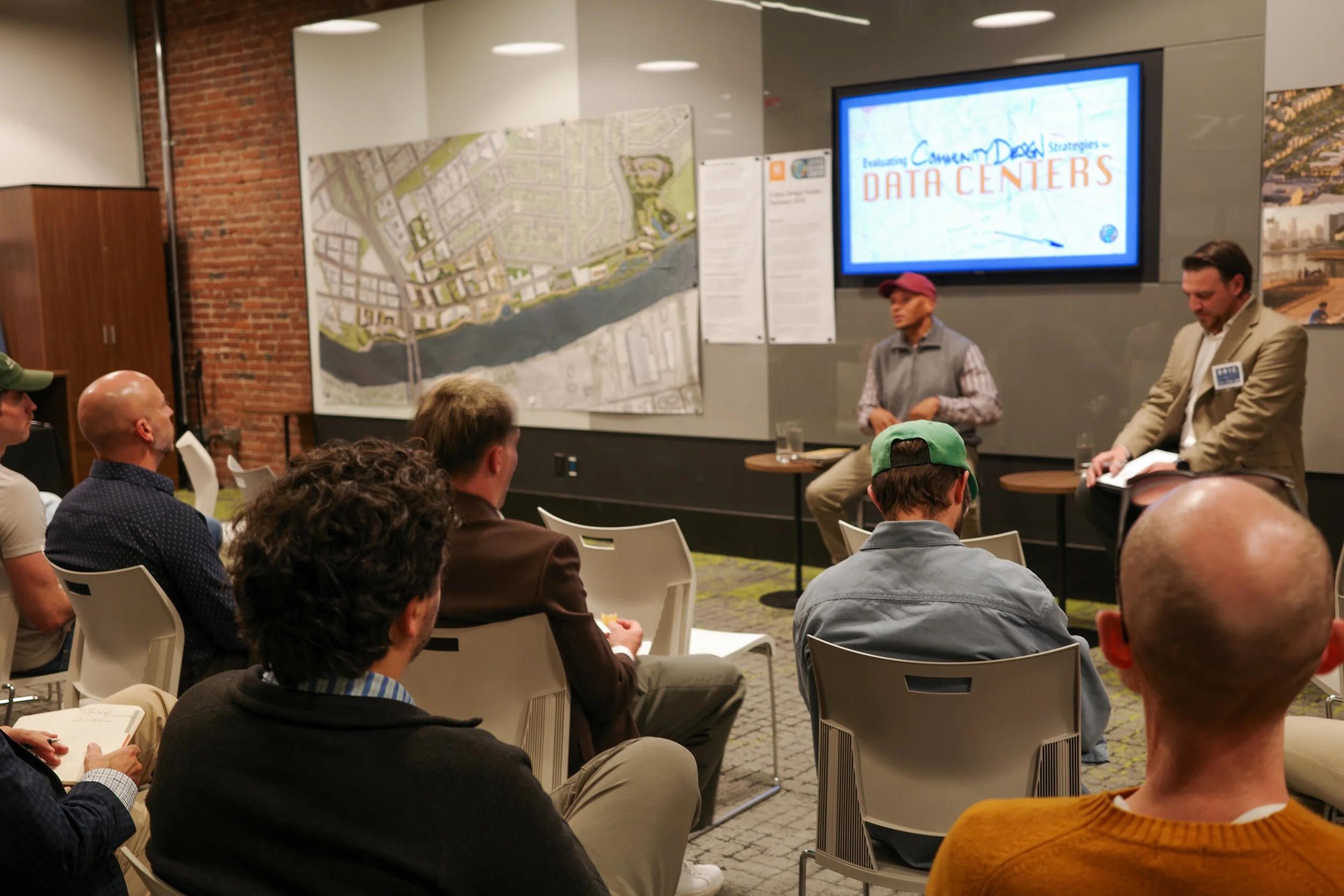
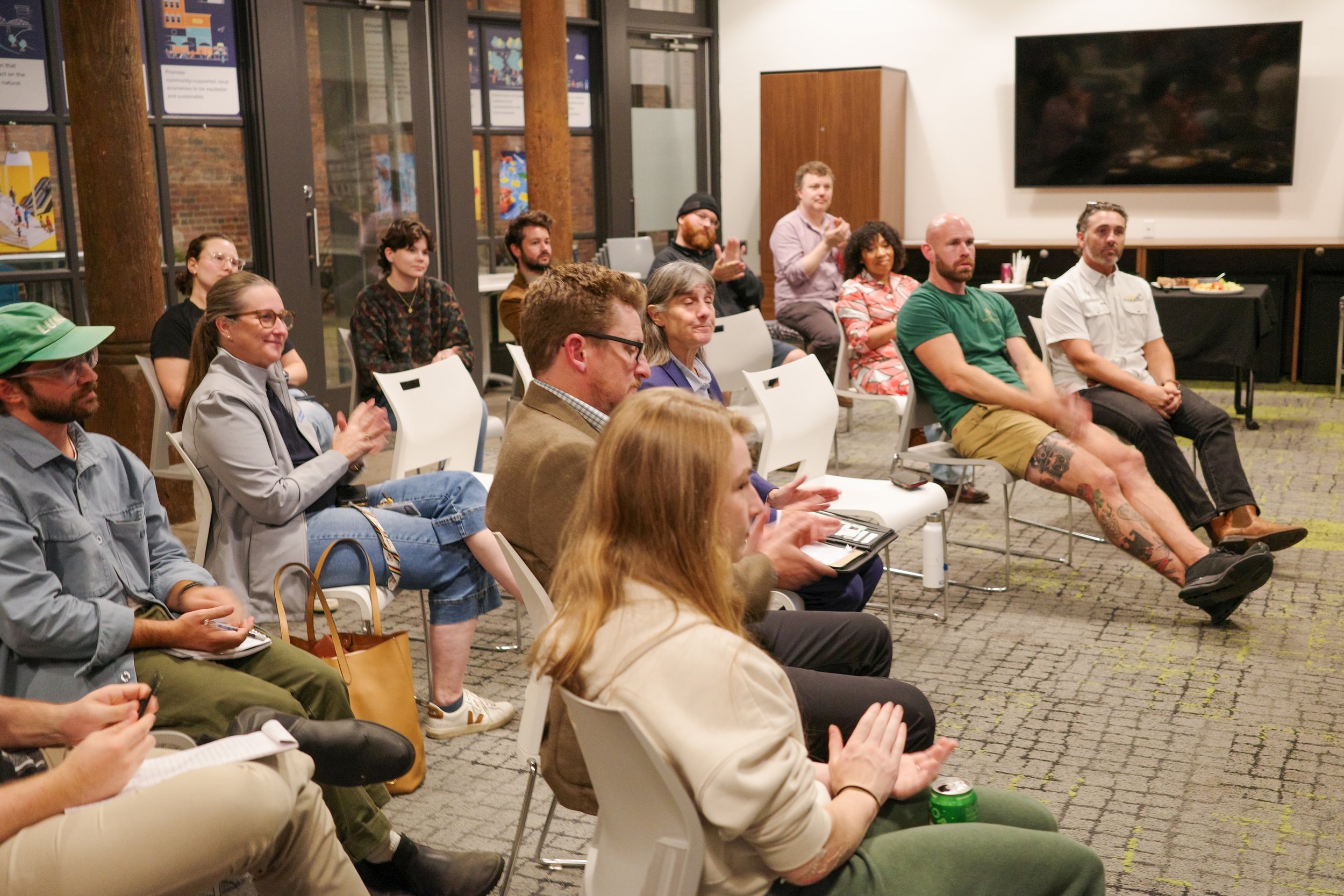
On November 4, just one day after Tennessee’s gubernatorial election, we hosted Evaluating Community Design Strategies for Data Centers to unpack what these massive facilities actually mean for cities like ours. Joined by civic leaders including Councilmember Burkley Allen and Vice Mayor Angie Henderson, I had the privilege of moderating a candid, eye-opening conversation with Khalil of the Natural Resources Defense Council (NRDC).
As urban designers, our instinct is often to look for architectural or site-planning fixes: better facades, vegetative buffers, or adaptive reuse of waste heat. Yet what became immediately clear during our conversation is that when it comes to hyperscale AI data centers, scale changes everything, and good site design alone cannot solve a fundamentally broken development model.
Why Local Rules Alone Can’t Hold the Line
Coming off an election where newly elected Governor Marsha Blackburn suggested data center oversight should be left to local municipalities, I asked Khalil what happens when cities are left to fend for themselves. Having worked on both national policy and a fight against an 860-megawatt proposal a mile from his own home in Maryland, his warning was blunt: leaving this to local governments sparks a "race to the bottom."
Even when cities pass well-intentioned ordinances capping square footage or megawatts, developers routinely exploit vague definitions, subdividing a massive campus into multiple 400,000-square-foot buildings to bypass a 500,000-square-foot cap. Unlike manufacturing plants that can be offshored, AI infrastructure relies on American power grids, fiber networks, and land. States hold real leverage, and as we are seeing in places like Ohio, which cut speculative "phantom" permit requests by 50% overnight simply by requiring developers to pay for grid upgrades upfront, strong state-level guardrails are essential to protect everyday ratepayers from subsidizing corporate infrastructure.
A Highway with No Off-Ramps
In civic design, we evaluate projects by the value they return to the surrounding neighborhood. Proponents often pitch data centers as an automatic ticket into the "digital economy," so I pressed Khalil on what economic development actually looks like on the ground.
He pointed right down I-40 to Memphis. Even though Memphis had an established "Digital Delta" strategy aimed at lifting up local logistics and minority-owned businesses, Elon Musk’s xAI Colossus supercomputer, packed with 300,000 GPUs, operates like a highway running straight through town with no off-ramps. Residents bear the burden of heavy air emissions and grid strain, yet the community has zero access to the computing power inside. Looking at Northern Virginia’s "Data Center Alley" tells a similar story: once construction ends, these windowless boxes employ only a skeleton crew. They don't generate foot traffic, support neighborhood retail, or spark local entrepreneurship. Too often, local leaders settle for a basic real estate deal when communities deserve true civic return.
When "Sustainable Design" Breaks Down at Scale
During the discussion, we also looked closer to home at the stalled proposal for a 30-megawatt data center at Fisk University in North Nashville, a campus embedded right in the middle of a single-family residential neighborhood. How do you mitigate the impacts of a single-use facility in a context like that?
Khalil drew a critical distinction between the everyday cloud and generative AI:
Everyday Digital Life (CPUs): Streaming movies, sending texts, and running Google searches rely on traditional CPU server racks (around 16 kilowatts per rack). In fact, a city the size of Nashville or Seattle only needs roughly 20 to 30 megawatts of capacity to meet all of its residents' daily digital needs. At that smaller scale, creative design strategies, like piping waste heat to warm nearby buildings or pairing facilities with community solar, can genuinely work.
Hyperscale AI (GPUs): Training massive AI models stacks power-hungry GPUs (up to 600 kilowatts per rack) that must run 24/7 without interruption. A single 1-gigawatt facility would require 12 million solar panels, roughly 5,000 football fields, to power cleanly. Because wind and solar are intermittent and industrial batteries degrade quickly, hyperscale facilities inevitably lock communities into natural gas, banks of noisy diesel backup generators, and roaring industrial HVAC systems.
Designing for Community Need First
Perhaps the most powerful takeaway for Nashville came near the end of the night, when Khalil shared how a South African agency evaluated a proposal from a major US cloud provider. Instead of asking how to accommodate the developer, they asked a much simpler question: We already have enough computing capacity to meet our country’s needs, so who is this facility actually for?
As Nashville continues to grow and navigate pressures on our grid, our land, and our neighborhoods, that is the exact question we need to put at the center of our civic design process. Before we hand over acreage, water, and megawatts to speculative hyperscale campuses, we should start by defining our own community's computational needs, and insisting that whatever we build actually serves the people who live here.
Where Nashville stands
In July 2026, Nashville passed policy BL2026-1391 to place guardrails on data center development across Davidson County, banning campuses larger than 500,000 square feet or using more than 100 megawatts of electricity. Under this legislation, smaller approved facilities are restricted to heavy industrial zones and must undergo a Board of Zoning Appeals special exception and public hearing, maintain buffer distances ranging from 100 feet to half a mile from sensitive sites like homes, schools, parks, and the Zoo, utilize closed-loop water cooling, prove adequate local utility capacity, and adhere to heavy restrictions on on-site fossil-fuel gas turbine generators. This legislative push followed Mayor O’Connell’s June 15, 2026 signing of Executive Order 59, which directed city departments to study the environmental, economic, and infrastructure impacts of large-scale facilities, and coincided with intense local controversy, including community protests over a proposed facility at Fisk University and committee-level council efforts to explore eminent domain near the Zoo to block a DC Blox project. To give officials time to evaluate further policy needs, the council also enacted BL2026-1448, a temporary moratorium on new data center permits and construction set to expire on December 1, 2026.
Moving forward, the community is discussing forming a coalition of supporters to prevent developers from building unregulated facilities on the outskirts of our community to skirt local rules, while urging our planning department to extend the December 1 moratorium until we can hold a broader, city-wide conversation on long-term policy.